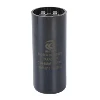
In actual operation, the performance and lifespan of power capacitors are constrained by a variety of complex factors. A careful analysis of these factors is crucial for ensuring the stable operation of power systems and extending the service life of the capacitors.
Impact of Voltage Fluctuations and Harmonic Pollution
The reactive power output of a capacitor is proportional to the square of its terminal voltage. When system voltage rises, the capacitor may operate under overload conditions, leading to increased internal dielectric losses and a sharper rise in temperature; long-term operation under these conditions accelerates insulation aging. Conversely, excessively low voltage prevents the capacitor from providing effective compensation.
Furthermore, non-linear loads in modern power systems (such as variable frequency drives and rectifiers) generate significant harmonic currents. These harmonics can resonate with the capacitor's capacitive reactance, causing the capacitor to operate under overcurrent conditions.
Ambient Temperature and Heat Dissipation
Poor heat dissipation causes the internal temperature of the power capacitor to rise continuously, significantly reducing its actual service life. High temperatures accelerate the aging of the insulating dielectric, leading to reduced dielectric strength and an increased loss tangent, creating a vicious cycle. Low-temperature environments are also detrimental, as they can intensify internal partial discharge.
Therefore, the installation environment for power capacitors must ensure good ventilation and heat dissipation, avoiding direct sunlight or proximity to other heat sources; forced ventilation measures may be required during hot seasons.
Switching Operations and Overvoltage Surges
Frequent switching of power capacitor banks generates switching overvoltages and inrush currents, causing severe damage to the capacitors. The moment of energization can produce inrush currents dozens of times higher than the rated current; although brief in duration, these surges deliver a massive, irreversible shock to the capacitor.
Dielectric Aging and Manufacturing Defects
The internal insulating dielectric undergoes an irreversible aging process due to the long-term effects of electric and thermal fields. Minute defects from the manufacturing process-such as impurities within the dielectric-can evolve into sources of partial discharge during long-term operation, ultimately leading to insulation breakdown.
Inadequate Operation, Maintenance, and Management Strategies
Deficient operation and maintenance management constitutes a human factor contributing to capacitor failures. Furthermore, poorly designed compensation schemes-such as fixed compensation that fails to adapt to load fluctuations or inefficient bank switching-can cause capacitors to operate under suboptimal conditions.